Purpose of study
Art, craft and design embody some of the highest forms of human creativity. A high-quality art and design education should engage, inspire and challenge pupils, equipping them with the knowledge and skills to experiment, invent and create their own works of art, craft and design.
As pupils progress, they should be able to think critically and develop a more rigorous understanding of art and design. They should also know how art and design both reflect and shape our history, and contribute to the culture, creativity and wealth of our nation.
The rationale behind the sequencing and structure of the Art and Design curriculum at ECS.
Key points to note:
- All children have a sketchbook which moves with them as they progress through each year group and represents the progress they make in all elements of the art curriculum
- Knowledge of drawing, painting, sculpture and other art, craft and design techniques and skills are integrated into units and pupils develop their understanding and application of these further each year.
- Pupils have the opportunities in each phase to use a wealth of visual and tactile elements and materials with a focus on developing increased confidence.
- All units support pupils to develop the ability to control materials, tools and techniques so that our pupils leave Year 6 with a solid knowledge and understanding of the formal elements of art and design such as line, tone, shape, space, texture, value and colour.
- All units include encountering and knowing the work of great artists, craft makers, architects or designers, and the historical and cultural development and significance of their art forms.
- Each phase builds on previous knowledge and experiences to foster an enjoyment and appreciation of the visual arts and a knowledge of artists, craftspeople, architects and designers.
- Evaluation and analysis of creative works using the language of art, craft and design is incorporated in art lessons and other subjects such as RE and History and pupils develop these further each year.
- Opportunities to record from their first-hand experiences as well as from their imagination are included throughout the sequence of units.
- Pupils develop creativity and imagination through a range of complex activities and have opportunities to select their own ideas for use in their work and articulate their reasons for their choices.
We continually review the fine detail of the curriculum content to ensure it meets the needs of our pupils. As a result, these ongoing small changes may not be reflected in the document above.
Purpose of study
A high-quality computing education equips pupils to use computational thinking and creativity to understand and change the world. Computing has deep links with mathematics, science, and design and technology, and provides insights into both natural and artificial systems.
The core of computing is computer science, in which pupils are taught the principles of information and computation, how digital systems work, and how to put this knowledge to use through programming. Building on this knowledge and understanding, pupils are equipped to use information technology to create programs, systems and a range of content.
Computing also ensures that pupils become digitally literate – able to safely use, express themselves and develop their ideas through, information and communication technology – at a level suitable for the future workplace and as active participants in a digital world.
The national curriculum for computing aims to ensure that all pupils:
- can understand and apply the fundamental principles and concepts of computer science, including abstraction, logic, algorithms and data representation
- can analyse problems in computational terms, and have repeated practical experience of writing computer programs in order to solve such problems
- can evaluate and apply information technology, including new or unfamiliar technologies, analytically to solve problems
- are responsible, competent, confident and creative users of information and communication technology.
The rationale behind the sequencing and structure of the computing curriculum at ECS.
Key points to note:
- The aim of the computing curriculum is to instil a passion for technology whilst developing a firm knowledge, understanding and respect of how technology contributes to the world we experience. We prioritise teaching children how to keep themselves and others safe online whilst celebrating their individual identities through their creativity. This is supported by the strong links between our Computing and SCARF curriculum.
- We have a spiral curriculum which means the pupils revisit and build on previously taught concepts which allows for consolidation to take place and for new learning to be gained on top of secure foundations. The structure and sequencing of the curriculum, enables this to take place.
Structure (taken from the Teach Computing Programme of Study created by the National Centre for Computing Education):
Every year group completes six units with the following themes:
- Computing systems and networks
- Programming x 2
- Data and Information
- Creating media x 2
Throughout all themes, there is also a focus on:
- the effective use of tools
- the impact of technology
- safety and security
Each theme and unit is underpinned with the following ten strands with the intended outcomes:
- Algorithms: Be able to comprehend, design, create and evaluate algorithms
- Computer networks: Understand how networks can be used to retrieve and share information, and how they come with associated risks
- Computer systems: Understand what a computer is, and how its constituent parts function together as a whole
- Creating media: Select and create a range of media including text, images, sounds and video
- Data and information: Understand how data is stored, organised, and used to represent real-world artefacts and scenarios
- Design and development: Understand the activities involved in planning, creating, and evaluating computing artefacts
- Effective use of tools: Use software tools to support computing work
- Impact of technology: Understand how individuals, systems, and society as a whole interact with computer systems
- Programming: Create software to allow computers to solve problems
- Safety and security: Understand risks when using technology, and how to protect individuals and systems
We continually review the fine detail of the curriculum content to ensure it meets the needs of our pupils. As a result, these ongoing small changes may not be reflected in the document above.
Purpose of study
Design and technology is an inspiring, rigorous and practical subject. Using creativity and imagination, pupils design and make products that solve real and relevant problems within a variety of contexts, considering their own and others’ needs, wants and values.
They acquire a broad range of subject knowledge and draw on disciplines such as mathematics, science, engineering, computing and art. Pupils learn how to take risks, becoming resourceful, innovative, enterprising and capable citizens.
Through the evaluation of past and present design and technology, they develop a critical understanding of its impact on daily life and the wider world. High-quality design and technology education makes an essential contribution to the creativity, culture, wealth and well-being of the nation.
The rationale behind the sequencing and structure of the design and technology curriculum at ECS.
Key points to note:
- During each phase (KS1, LKS2 and UKS2) all pupils will have the opportunity to develop their skills and knowledge in design, structures, mechanisms, electrical control and a range of materials including food and textiles.
- Pupils will be given the opportunity to develop skills, knowledge and understanding of designing and making functional products for specified users.
- In each design and technology project, there will be three core activities which are combined into a sequence to create project activities which involve investigating and evaluation existing products; focused tasks in which children develop particular aspects of knowledge and skills; designing and making activities in which children design and make ‘something’ for ‘somebody’ for ‘some purpose’.
- Developing relationships with local secondary schools to promote opportunities and experiences within the subject
- STEM afterschool club to inspire and further develop the knowledge and skills of pupils through an introduction to engineering by invention and making processes.
We continually review the fine detail of the curriculum content to ensure it meets the needs of our pupils. As a result, these ongoing small changes may not be reflected in the document above.
Purpose of study
A high-quality geography education should inspire in pupils a curiosity and fascination about the world and its people that will remain with them for the rest of their lives. Teaching should equip pupils with knowledge about diverse places, people, resources and natural and human environments, together with a deep understanding of the Earth’s key physical and human processes.
As pupils progress, their growing knowledge about the world should help them to deepen their understanding of the interaction between physical and human processes, and of the formation and use of landscapes and environments. Geographical knowledge, understanding and skills provide the frameworks and approaches that explain how the Earth’s features at different scales are shaped, interconnected and change over time.
The rationale behind the sequencing and structure of the geography curriculum at ECS.
Key points to note:
- All units are planned to develop these key geographical (Geography’s big ideas) concepts: place, space, scale, environmental impact and sustainability, interconnections, cultural awareness and diversity
- All pupils should develop a depth of understanding behind the difference between human and physical geography.
- Each unit develops pupils’ locational knowledge and understanding of geographical similarities and differences between places.
- Pupils develop an understanding of interconnections between features, places, events and people over units across each phase
- Knowledge of and ability to use geographical vocabulary correctly to communicate knowledge of human and physical features is developed
- All units develop pupils’ ability to enquire, question and discover geographical knowledge collaboratively with peers and independently
- Fieldwork and map skills are integrated into units and pupils develop these further each year
- Each phase revisits and deepens knowledge of the school’s locality and compares this with a range of other localities and geographical themes.
We continually review the fine detail of the curriculum content to ensure it meets the needs of our pupils. As a result, these ongoing small changes may not be reflected in the document above.
Purpose of study
A high-quality history education will help pupils gain a coherent knowledge and understanding of Britain’s past and that of the wider world. It should inspire pupils’ curiosity to know more about the past. Teaching should equip pupils to ask perceptive questions, think critically, weigh evidence, sift arguments, and develop perspective and judgement.
History helps pupils to understand the complexity of people’s lives, the process of change, the diversity of societies and relationships between different groups, as well as their own identity and the challenges of their time.
The rationale behind the sequencing and structure of the history curriculum at ECS.
Key points to note:
- Pupils develop an understanding behind how and why the world, our country, culture and local community have developed over time by understanding how the past influences the present
- All units build on pupils’ previous knowledge of significant events and people, situations and developments from a wide range of backgrounds and places to reflect and celebrate our diverse society
- All pupils should develop a context for their growing sense of identity and a chronological framework for the knowledge of significant events and people
- All units of history begin with an enquiry question and are designed to stimulate pupils’ curiosity, reflect on their existing knowledge and encourage them to question historical events, viewpoints and evidence
- Pupils develop an understanding of historical concepts such as continuity and change, cause and consequence, similarity, difference and significance. By the time pupils leave us in Year 6 they can use this solid knowledge to make connections, draw contrasts, analyse trends, frame historically valid questions and create their own structured accounts, analyses, arguments and interpretations of the past
- All units refer to and develop pupils’ understanding and knowing of the historical chronological narrative, from the earliest times to the present day: how people’s lives have shaped Britain and how Britain has influences and been influenced by the wider world
- All units integrate methods of historical enquiry, including how evidence is used rigorously to make historical claims, and discern how and why contrasting arguments and interpretations of the past have been constructed
- Knowledge of and ability to use historical vocabulary correctly to communicate knowledge and deploy a historically grounded understanding of abstract terms such as ‘empire’, civilisation’, ‘parliament’, and ‘peasantry’
We continually review the fine detail of the curriculum content to ensure it meets the needs of our pupils. As a result, these ongoing small changes may not be reflected in the document above.
Purpose of study
Mathematics is a creative and highly inter-connected discipline that has been developed over centuries, providing the solution to some of history’s most intriguing problems. It is essential to everyday life, critical to science, technology and engineering, and necessary for financial literacy and most forms of employment. A high-quality mathematics education therefore provides a foundation for understanding the world, the ability to reason mathematically, an appreciation of the beauty and power of mathematics, and a sense of enjoyment and curiosity about the subject.
The rationale behind the sequencing and structure of the Maths curriculum at ECS.
Key points to note:
- Our curriculum aims to ensure that all pupils become fluent in the fundamentals of mathematics; can reason mathematically which includes making generalisations and conjectures and can solve problems by applying their deep understanding of concepts within the appropriate stage of their learning
- Our curriculum supports our pupils so they leave Year 6 with strong, efficient and effective mental and written calculation methods for all four operations; secure knowledge and understanding of the place value of numbers up to ten million; secure knowledge and application of their multiplication tables; a firm understanding and handling of the relationship between fractions, percentages, decimals and ratio; the ability to select and use appropriate tools to complete tasks involving measurement, geometry and statistic
- Vocabulary has a high profile in all lessons so children can use correct mathematical language to both develop and explain their conceptual understanding both verbally and in writin
- Application of mathematical ideas and understanding is applied within other subjects such as science and computing to support the building of knowledge and creation of links as well as the application of skills
- Our curriculum is based on the principles of ‘maths mastery’ which means we focus on our pupils acquiring a deep, long-term, secure and adaptable understanding of the subject which then enables them to move on to more advanced material
- We deliver our curriculum using White Rose Maths whose resources are meticulously designed by expert teachers and reflect a commitment to excellence. Rooted in research on the teaching for mastery approach, they provide a comprehensive progression for pupils with a rich bank of teaching resources.
- Coherence: Lessons are broken down into small steps so that knowledge and understanding can be extended.
- Representation and Structure: At the heart of our mastery approach is the Concrete Pictorial Abstract (CPA) approach. When children are introduced to a new concept, working with concrete physical resources and pictorial representations leads to a better understanding of abstract concepts. We use CPA throughout our schemes of learning.
- Mathematical Thinking: We believe confidence with numbers is the first step to competency in the curriculum as a whole. By putting depth before breadth, we reinforce knowledge again and again. Focuses on fluency, reasoning and problem solving:
- Fluency: We give children the skills they need to become competent mathematicians by teaching quick and efficient recall of facts and methods and the flexibility to move between different contexts and representations of mathematics
- Reasoning: We provide opportunities for our children to reason mathematically by following a line of enquiry, conjecturing relationships and generalisations, and developing an argument, justification or proof using mathematical language
We continually review the fine detail of the curriculum content to ensure it meets the needs of our pupils. As a result, these ongoing small changes may not be reflected in the document above.
At Esher Church School we believe that music is a vital part of the children’s education and offer a rich and varied curriculum to aid learning academically, emotionally, physically and spiritually.
Each class in Key Stages 1 and 2 have regular music lessons which give children the opportunity to listen to, sing, compose and perform music both individually and in groups. Children perform on a wide range of tuned and un-tuned percussion instruments. For one term children in years 3 and 4 learn to play the recorder and children in years 5 and 6 learn to play simple tunes on the keyboard. Each year group performs some world music, experiencing Samba, African, Indian, Chinese and Gamelan Music. Year 6 children experience ‘Garage music’ and Stomp.
Each Key Stage puts on a production to showcase their musical and dramatic skills. ‘Encore’, our annual Performing Arts Celebration, which allows a wide range of groups to perform.
In addition, we run a range of school music clubs for our children including recorder, school orchestra and infant and junior choirs – all of whom perform beautifully at our seasonal occasions and at local care homes.
We continually review the fine detail of the curriculum content to ensure it meets the needs of our pupils. As a result, these ongoing small changes may not be reflected in the document above.
Purpose of study
At ECS, our MFL is Spanish.
Learning a foreign language is a liberation from insularity and provides an opening to other cultures. A high-quality languages education should foster pupils’ curiosity and deepen their understanding of the world. The teaching should enable pupils to express their ideas and thoughts in another language and to understand and respond to its speakers, both in speech and in writing.
It should also provide opportunities for them to communicate for practical purposes, learn new ways of thinking and read great literature in the original language. Language teaching should provide the foundation for learning further languages, equipping pupils to study and work in other countries.
The rationale behind the sequencing and structure of the MFL curriculum (Spanish) at ECS.
Key points to note:
- The MFL curriculum is delivered in blocks of learning that develop pupils’ knowledge of topic vocabulary underpinned by the learning of key grammatical structures and skills relevant to the Key Stage that underpin all learning. This will enable pupils to understand and communicate ideas, facts and feelings in speech and writing, focused on familiar and routine matters.
- There is a sequential approach to language learning and pupils need to be able to make the links between current and prior learning. Further opportunities to make links between home taught languages will encourage an overall passion.
- The teaching in Spanish will lay the foundations for further foreign language teaching at key stage 3.
Modern Foreign Languages – subject on a page
We continually review the fine detail of the curriculum content to ensure it meets the needs of our pupils. As a result, these ongoing small changes may not be reflected in the document above.
At Esher Church School we are committed to giving our children a plethora of opportunities to participate in both competitive and non-competitive sporting activities both within and outside of the school day.
We are fortunate to have a large playing field and hard court area, our own heated outdoor swimming pool as well as a school hall allowing all of our children to engage in Physical Education (PE) and school sport.
In PE lessons we aim to team up with specialist coaches in different sporting disciplines to ensure that our children have access to quality provision. We are fortunate to be situated next door to Esher Tennis Club, meaning our children benefit from access to specialist coaching and the use of their facilities. We also have excellent links with some of the best local specialist sports providers, such as Surbiton Hockey Club, Sport England and Surrey Football Coaching to ensure that our children have access to the very best sporting provision.
We offer a wide range of co-curricular clubs before and after school; these clubs are fully inclusive and open to all. We have many competitive teams who perform extremely well in sports such as cricket, cross country running, football, hockey, netball, swimming and tag rugby and we also participate in sports festivals to introduce children to new disciplines such as badminton, dodgeball and table tennis.
For more information visit Co-Curricular Clubs
We continually review the fine detail of the curriculum content to ensure it meets the needs of our pupils. As a result, these ongoing small changes may not be reflected in the document above.
Purpose of study
Personal, Social, Health, Citizenship and Economic (PSHCE) education is the curriculum subject through which pupils develop the knowledge, skills and attributes they need to manage their lives now and in the future.
It helps our children to stay physically and emotionally healthy and safe whilst preparing them to make the most of their lives within society.
At Esher Church School our vision for PSHCE and Relationships and Sex Education (RSE) is that all of our children will feel safe, valued and confident to develop themselves, their understanding of the world and their ability to communicate their feelings so that they feel equipped to manage their futures as they embark on their next steps and beyond. We intend for the children to learn ways to care for each other, respect and empathise difference, and become valued members of their communities and agents of change.
Key Points to Note
Our spiralling knowledge and life-skills based curriculum gives all children the opportunity to revisit key themes throughout their years at ECS and to develop a deeper appreciation and understanding of these topics. Provision is taught through engaging, thought-provoking, active and inclusive learning using the core headings of: Me and My Relationships, Valuing Difference, Keeping Safe, Rights and Respect, Being My Best and Growing and Changing.
PSHCE education cannot exist in isolation with close cross-curricular links to: Science (RSE) Computing (Online Safety) RE (Relationships) and PE (Health).
At ECS we recognise the role that PSHCE is at the heart of everything that we do, from the importance of embedding our Cornerstones of, Ready, Respectful, Safe, to our Christian Values of Community, Wisdom and Courage.
Whole school initiatives such as: UNICEF’s Rights Respecting Schools Award, Eco Schools’ Award, British Values Collective worship, Playground Friends, Big Friends/Little Friends, School Parliament and commitment to Anti-Bullying all compliment the high-quality teaching and learning of PSHCE throughout the whole school from Reception through to Year 6.
We continually review the fine detail of the curriculum content to ensure it meets the needs of our pupils. As a result, these ongoing small changes may not be reflected in the document above.
How we teach reading at Esher Church School
Reading is at the heart of learning. At Esher Church School, we help children become confident, fluent readers through a balanced approach that focuses on two key areas:
- Word Reading – recognising and decoding words quickly and accurately
- Comprehension – understanding and enjoying what they read
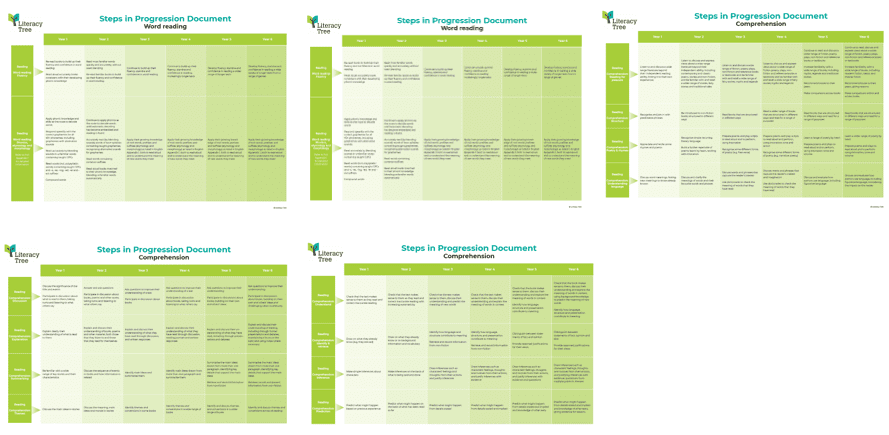
Click on the link or image below for the Literacy Tree Reading and Comprehension grids.
Reading Progression Literacy Tree 2024
Reading for Pleasure
Reading for pleasure is a major influence on educational success and personal wellbeing. Children who enjoy reading are more likely to read widely, think deeply and develop empathy and imagination. At Esher Church School we nurture a love of reading from the start to inspire a lifelong love of books and stories.
For example, children enjoy:
- Daily Storytime
- Whole-class reading sessions with a rich, mapped-out book diet
- Poetry lessons, including performance and memorisation
- Carefully curated book corners featuring focus authors
- Weekly reading-for-pleasure books to take home
- Mystery guest readers
Early Reading and Phonics
We believe that fluent reading and writing begin with strong phonics teaching. Our daily phonics lessons follow the Little Wandle Letters and Sounds Revised programme, starting in Reception. Children learn how letters represent sounds and how these combine to form words. This structured approach builds on prior knowledge and equips pupils to decode unfamiliar words confidently.
Phonics strategies are modelled across the curriculum and we place a strong emphasis on developing children’s language skills – because speaking and listening underpin success in reading and writing.
For children needing extra support, we provide targeted phonics intervention throughout the school. Parents play a vital role and phonics homework helps reinforce learning at home.
If you are a parent and would like more information about how to support your child with phonics at home, please follow the link below to find the Reception and Year 1 overview as well as videos of the sound pronunciations, letter formation sheets and other helpful resources .
https://www.littlewandlelettersandsounds.org.uk/resources/for-parents/
Reading Practice in Early Years & KS1
Children in Reception, Year 1, and Year 2 (and beyond if needed) take part in small-group reading sessions using fully decodable books matched to their phonics level. These books are then sent home to share success with families.
We assess phonics regularly:
- Half-termly assessments using the Little Wandle tracker
- Immediate ‘keep-up’ sessions for children at risk of falling behind
- Year 1 pupils complete the statutory Phonics Screening Check in summer
Reading in Key Stage 2
We teach reading through a whole-text approach using The Literacy Tree units. These high-quality texts reflect diverse experiences and help children explore important themes, deepen comprehension and develop their own writing voice.
Our approach includes:
Whole-book engagement: Pupils read entire texts rather than extracts, allowing them to follow narrative arcs, explore character development and understand thematic depth. This builds stamina, confidence and a genuine connection with literature.
Exposure to a wide range of literature: Children explore novels, poetry, and non-fiction texts that reflect a variety of voices and perspectives. This broadens their understanding of the world and helps them see themselves – and others – represented in what they read.
Explicit teaching of vocabulary and literary language: Teachers introduce and explore new vocabulary in context, helping pupils understand nuanced meanings and use rich language in their own writing. Literary devices such as metaphor, simile and personification are unpacked and discussed.
Rich classroom discussion and oracy development: Pupils are encouraged to articulate their ideas, ask questions, and build on others’ contributions. These discussions deepen comprehension and foster critical thinking, empathy and respectful debate.
Modelled reading and questioning: Teachers demonstrate fluent reading and model how to ask and answer questions that probe meaning, inference and authorial intent. This scaffolds pupils’ own analytical skills.
Collaborative tasks: Group activities such as role-play, shared annotations and thematic debates promote enjoyment and collective understanding. Pupils learn to listen, respond and co-construct meaning.
Creative responses to texts: Children engage with texts through drama, art, writing and multimedia projects. These activities help them internalise themes and express personal interpretations in imaginative ways.
Demonstrating comprehension across whole texts: Pupils learn to summarise, infer, predict, and evaluate. They respond to texts through structured written tasks, discussions and presentations that show a deep understanding of content and context.
Reading across the curriculum
Reading is embedded in all subjects. Classroom book corners feature age-appropriate, high-quality literature across genres. Pupils are encouraged to read these books at home and share their thoughts with peers and adults in school.
Purpose of study
As a Church school, where pupils and staff come from all faiths and none, Religious Education is a truly valued academic subject that enables pupils to understand how religion and beliefs affect our lives and the world around us.
At Esher Church School Religious Education contributes to pupils’ and education by provoking challenging questions about meaning and purpose in life, beliefs (religious and non-religious), issues of right and wrong and what it means to be human. In RE they learn about and from worldviews, including Christianity and other principal religions and beliefs (including non-religious perspectives such as Humanism) in local, national and global contexts, to discover, explore and consider different answers to these questions. (Surrey Agreed Syllabus 2023)
Aims and objectives
As stated in the Church of England Statement of Entitlement for Religious Education, our school aims for all pupils:
- To know about and understand Christianity as a diverse global living faith through the exploration of core beliefs using an approach that critically engages with biblical text.
- To gain knowledge and understanding of a range of religions and worldviews appreciating diversity, continuity and change within the religions and worldviews being studied.
- To engage with challenging questions of meaning and purpose raised by human existence and experience.
- To recognise the concept of religion and its continuing influence on Britain’s cultural heritage and in the lives of individuals and societies in different times, cultures and places.
- To explore their own religious, spiritual and philosophical ways living, believing and thinking
Religious Education in EYFS (This is taken from the Surrey Agreed Syllabus)
The RE curriculum for the EYFS always starts from where the children are, often taking a child’s-eye view and drawing upon their personal experiences. The curriculum allows children to explore the world around them from this starting point. In our school we organise our EYFS curriculum through themed units that allow RE learning to be intertwined with this.
Religious Education in Key Stage One (This is taken from the Surrey Agreed Syllabus)
Pupils develop their knowledge and understanding of the worldviews, beliefs and ‘lived experience’ of some Christian, Jewish and Muslim people, and some non-religious people.
Pupils become more aware of other peoples’ worldviews and are encouraged to develop important subject-specific and cross-curricular skills.
Religious Education in Lower Key Stage Two (This is taken from the Surrey Agreed Syllabus)
Pupils extend their knowledge and understanding of the beliefs and lived experience of some Christian, Jewish and Muslim people and are introduced to the importance of equality to Sikhs, and the Golden Rule to Humanists, recognising the impact of religion and belief on people’s worldviews, locally (including within their own school), nationally and globally. Pupils make connections across their learning in the thematic units and deepen their understanding of concepts within and across religions / beliefs.
Pupils are encouraged to become more self-reflective in the way that they understand their own personal worldview and the things that may have influenced it. They will also continue to develop important subject-specific and cross-curricular skills.
Religious Education in Upper Key Stage Two (This is taken from the Surrey Agreed Syllabus)
Pupils further develop their understanding of the beliefs and lived experience of some Christian, Jewish, Muslim & non-religious people, and are introduced to Hindu (Sanatana) Dharma and Buddhism. As learning develops across this phase, pupils will increasingly become aware of the factors that might account for diversity within and across communities, including opportunities to consider how some sacred texts can be interpreted in different ways e.g. creation stories.
Pupils continue to explore their own personal worldview and begin to articulate some of the factors that may have influenced it, also applying their thinking to help them to understand the worldviews of others.
Religious Education – subject on a page
Religious Education whole school overview
We continually review the fine detail of the curriculum content to ensure it meets the needs of our pupils. As a result, these ongoing small changes may not be reflected in the document above.
Purpose of study
An unapologetically ambitious science curriculum provides the foundations for understanding the world through the specific disciplines of biology, chemistry and physics and how they are connected. Science changes lives and is vital to the world’s future prosperity. All pupils should be taught essential aspects of the knowledge, vocabulary, methods, processes and uses of science.
Through building on and the deliberate revisiting of key foundational knowledge and concepts, pupils should feel encouraged to be curious learners who are inquisitive and feel empowered to ask scientific questions whilst developing their ability to respond using substantive and disciplinary knowledge.
They should be encouraged to make connections between the scientific content and the context in which it is relevant to their everyday lives and the world around them.
The rationale behind the sequencing and structure of the Science curriculum at ECS.
Key points to note:
- Pupils are enabled to build secure foundational knowledge and sophisticate their understanding through the deliberate revisiting of complex concepts and content.
- Pupils are taught how to ‘work and think scientifically’, developing an understanding of the processes and methods of science. Working and thinking scientifically is embedded within each lesson, seeking answers through investigation and experimentation, then through collecting, analysing and presenting data.
- Pupils are helped to build and develop their understanding of scientific ideas by using different lines of scientific enquiry to answer questions, including observing changes over time, noticing patterns, grouping and classifying, comparative and fair tests, and finding things out using secondary sources of information.
- Children are encouraged and equipped to use ambitious scientific vocabulary to discuss what they have discovered and communicate their thoughts and ideas. Pupils build up an extended specialised vocabulary over their time at ECS that builds on their prior knowledge, supports the extending of that knowledge and encourages them to find connections within their learning.
We continually review the fine detail of the curriculum content to ensure it meets the needs of our pupils. As a result, these ongoing small changes may not be reflected in the document above.
How We Teach Writing at Our School
At our school, we believe that every child has the potential to be a writer. Writing is a craft built step-by-step, where sentences serve as the fundamental building blocks that help children express their ideas clearly and effectively.
Learning Through Carefully Chosen Texts
We use units from The Literacy Tree centred around carefully selected, high-quality texts. These texts enable us to explore a wide variety of stories and subjects, featuring diverse characters and experiences that both reflect our school community and broaden children’s understanding of the world beyond. Immersing children in these rich texts encourages thoughtful exploration of important themes and helps develop their own writing voice.
Writing with Purpose and Audience
Our writing programme places a strong emphasis on writing for real, meaningful purposes and authentic audiences. Whether crafting a narrative, letter, or report, children learn to consider who they are writing for and why. This focus ensures that their writing is relevant, purposeful and engaging.
Sentences as Building Blocks of Writing
We teach children to understand writing as a coherent structure built from clear and effective sentences. Each sentence is a vital part of communicating ideas, and we guide students in constructing sentences that are well-formed, varied and logically sequenced to create compelling writing.
Celebrating Published Work
We recognise the importance of celebrating children’s writing achievements. Regular showcases give children the opportunity to share their published work with peers, families and the wider community, fostering pride and motivation in their writing journey.
Integrating Grammar, Spelling, and Handwriting
Grammar and spelling are taught explicitly within the context of meaningful writing, enabling children to apply these skills purposefully rather than in isolation. Additionally, discrete lessons support the development of handwriting and spelling to enhance fluency and accuracy.
Learning from Exemplars
Children analyse high-quality model texts to identify effective writing techniques and structures. This analytical approach equips them with the tools to emulate and innovate in their own writing.
Gradual Release Model of Instruction
Our teachers use a gradual release framework: modelling writing (“I do”), guided practice (“we do”), and independent application (“you do”). This scaffolded approach builds children’s confidence and independence as writers.
Supporting Every Learner
We maintain high expectations for all students and provide targeted support where needed. Through quality first teaching, scaffolding and differentiation, we ensure every child can engage with and progress in the writing process.
Alignment with the New Writing Framework
Our writing curriculum reflects the key principles of the new Writing Framework, including:
- Writing with clear purpose and audience in mind.
- Emphasising the full writing process from planning through to publication.
- Embedding grammar and spelling instruction within authentic writing experiences.
- Setting high expectations for all children to be confident writers with appropriate support.
- Valuing the celebration of children’s writing achievements.
Writing is a journey of continuous improvement. With every sentence written, our children develop as articulate, thoughtful and confident communicators ready to share their ideas with the world.
Click on the image below to see the Literacy Tree progression in writing.

We continually review the fine detail of the curriculum content to ensure it meets the needs of our pupils. As a result, these ongoing small changes may not be reflected in the document above.